A baby rests in its basket – sheltered, still, barely visible. The Ejiko form, originally inspired by the wooden carrying baskets in which children of the Tōhoku region were cradled during fieldwork, is here reduced to its emotional essence: protection, warmth, and a sense of being held. This Kokeshi variant has long been regarded as an expression of maternal care – and Hideyuki Sato carries that tradition forward with an unmistakable boldness of colour.
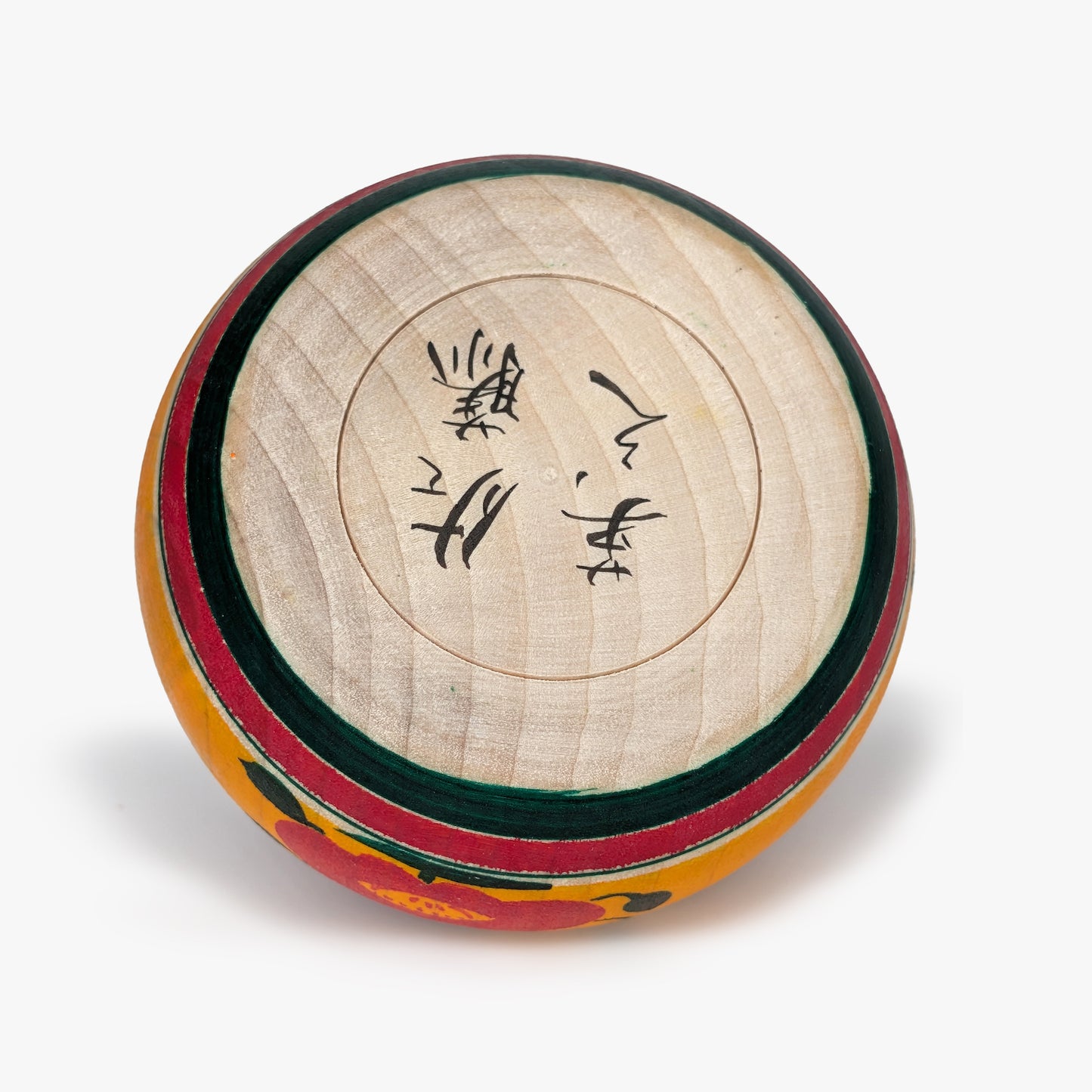
The bowl glows in deep orange. Across the outer wall, three hand-painted motifs spanning the cycle of the seasons: Ume branches in red and black – calligraphic, linear; a Tsubaki blossom in deep red with green leaves and a yellow centre; Kiku chrysanthemums in red and dark green, rendered with a broad brushstroke, almost painterly. At the upper edge, a Rokuro-Moyo band in red and green. Viewed from above, the bowl reveals its true face: wide concentric rings in red, orange, and green – turned, rhythmic, abstract.
Nestled inside sits the Kokeshi figure: a round head, closed eyes in the Fuse-me style, a delicate smile, rosy cheeks. The black hair crown bears red decorative blossoms along the hairline. From above: matt black, with a single red circle at the centre – reduced to the absolute minimum.
Features
Ejiko-Kokeshi in the Yajiro tradition
Bowl: orange ground, three motifs – Ume, Tsubaki, Kiku
Hideyuki Sato represents the third generation of the long-established Kijidokoro Sato workshop. As a Kokeshi kōjin, he masters the complete process, from selecting and preparing the wood to turning, painting and finishing each individual Kokeshi.